
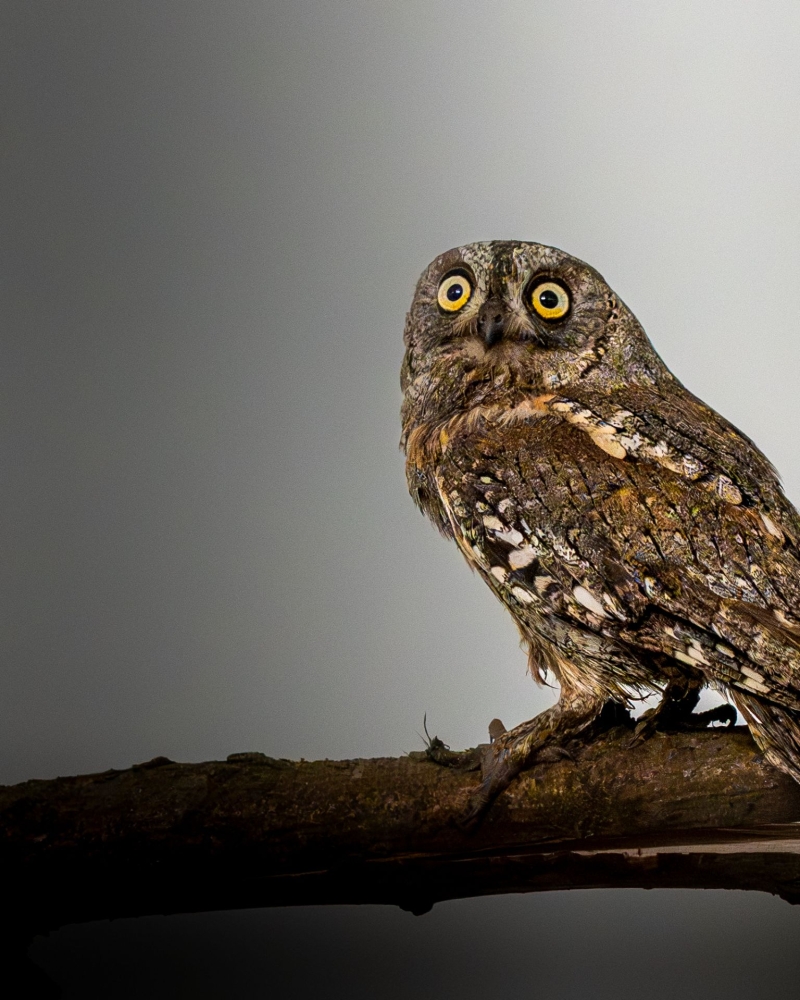
Eurasian scops owl Otus scops
Animals in our sanctuary
Valencia
Eurasian scops owl Valencia was confiscated by Animal Welfare Belgium, along with other owl species and birds of prey.
Málaga
Eurasian scops owl Málaga was confiscated by Animal Welfare Belgium, along with other owl species and birds of prey.
Nice
Eurasian scops owl Nice was confiscated by Animal Welfare Belgium, along with other owl species and birds of prey.
Cannes
Eurasian scops owl Cannes was confiscated by Animal Welfare Belgium, along with other owl species and birds of prey.
Montpellier
Eurasian scops owl Montpellier was confiscated by Animal Welfare Belgium, along with other owl species and birds of prey.
Savona
Eurasian scops owl Savona was confiscated by Animal Welfare Belgium, along with other owl species and birds of prey.
Livorno
Eurasian scops owl Livorno was confiscated by Animal Welfare Belgium, along with other owl species and birds of prey.
Athene
Eurasian scops owl Athene was confiscated by Animal Welfare Belgium, along with other owl species and birds of prey.
Monte Carlo
Eurasian scops owl Monte Carlo was confiscated by Animal Welfare Belgium, along with other owl species and birds of prey.
Where does he feel most at home?
The Eurasian scops owl has a very broad geographic range. The non-breeding geographic range is in Africa and includes the west African coast from Senegal southward to Liberia, to the east African coast from Sudan southward to Kenya. The range continues northward to the southern borders of Mauritania, Mali, Niger, Chad, and Sudan, and southward to the borders of Cameroon and Kenya.
The breeding range encompasses three continents: Europe, Africa, and Asia.
Eurasian scops owls are found in semi-open, arid landscapes. Breeding grounds typically are open habitats, rich in insects, that include large old trees with cavities. They can be found in rocky, mountainous regions, cultivated areas with groups of trees, and parks or gardens with mature trees.
What's his favourite food?
The Eurasian scops owl is largely nocturnal. It is insectivorous, preying mostly on insects such as moths, grasshoppers, cicadas, and beetles. Earthworms and spiders are also eaten, as well as small vertebrates such as geckos, frogs, small birds, or mice. Small birds and mammals make up only one percent of the scops owl diet.
The owl relies on excellent hearing in order to hunt. It will swoop down and capture insects using the beak. For slightly larger prey, the owl will swoop down from a perch and seize the vertebrate with the talons.
Fun fact
The Eurasian scops owl, also known as the European scops owl, common scops owl or just scops owl, is a very small owl with golden-yellow eyes. Cryptic and well-camouflaged, with streaky grey-brown plumage that blends in perfectly with tree bark. Small ear tufts raised when alert. The females typically weigh 15-25 grams more than the males.
The hoot of the male European scops owl is a single syllable. A female hoot is similar to that of the male, but is slightly higher pitched. When the scops owl is alarmed, both sexes will emit a loud and piercing call, to alert others of the danger.
European scops owls are typically solitary birds, but can form loose colonies. The owls will monogamously pair during the breeding season and polygyny can occur in rare instances. Once paired, both sexes will defend the territory through duetted vocal displays against the intruder.
Eurasian scops owls breed in open woodland, parks and gardens. The nest is usually a hole in a tree or in a wall, but can sometimes be an old nest of another species such as a crow. The clutch is usually three to five eggs. The eggs are incubated only by the female. They hatch after 24-25 days. The males will bring food to the females while she is incubating. The pair will work together to care for the young and defend the nest from intruders, using vocal defense.
Conservation
The IUCN Red List has listed the Eurasian scops owls as "Least Concern" due to the large range, while local population trends are not known. A decline has been seen in this species in developing areas, most likely a result of loss or fragmentation of habitat and reduction of insects through the use of pesticides.
Adopt this Eurasian scops owl